

Every hobby builds a dialect, and vaping’s grew fast and messy — a decade of hardware generations, forum slang, marketing coinages and regulatory vocabulary all layered into the way shops label shelves and vapers talk to each other. The result greets every newcomer at the counter: MTL or DL? Salts or freebase? What ohm? Sub-what? A beginner who cannot parse the dialect cannot ask good questions, compare products, read a label, or follow the very guides written to help them — which makes vocabulary, oddly, one of the most practical vaping skills there is. This guide is the full phrasebook: not an alphabetised dictionary to skim, but the working vocabulary organised the way the knowledge actually hangs together — hardware words, liquid words, technique words, performance words, and the regulatory and slang layers on top — each term defined in plain English with the context that makes it stick. Read it once and every other guide on how to vape, every shelf label and every shop conversation clicks into focus.
Hardware Words: The Machine
Start with the object itself. Device or mod: the battery-bearing body — ‘mod’ survives from the modified-torch era and now just means the larger, feature-rich end. Pod: the small liquid-holding cartridge that clicks into compact systems, containing its own coil; prefilled pods arrive loaded and sealed, refillable pods you fill yourself. Pod kit or pod system: the compact device-plus-pod format that dominates modern vaping. Tank: the larger screw-on liquid reservoir of traditional kits, with replaceable coils. Coil: the heating element and its wick, the consumable heart of everything — ‘changing the coil’ is replacing this unit. Wick: the cotton or similar material feeding liquid to the coil. Airflow: the air path past the coil, fixed or adjustable, whose tightness defines draw style. 510: the near-universal threading standard connecting tanks to mods, useful to know only when mixing brands. Draw-activated versus button-fired: whether inhaling alone triggers the device or a button does. And battery vocabulary: mAh as capacity (bigger lasts longer), built-in versus removable cells, USB-C as the charging standard worth insisting on.
Liquid Words: The Consumable
The bottle carries its own lexicon, covered deeply elsewhere in this series and compressed here. E-liquid, juice, vape liquid: synonyms. PG (propylene glycol): the thin base carrying flavour and throat hit; VG (vegetable glycerine): the thick base carrying vapour and smoothness; the ratio (50/50, 70/30) being the compatibility spec matching liquid to hardware. Nicotine strength: mg per ml, UK-capped at 20mg, also written as percent (20mg = 2%). Freebase: the original nicotine form, harsher as strength rises; nic salts or salts: the modern smooth-at-strength, fast-absorbing form that pod kits run on. Shortfill: a larger bottle of zero-nicotine liquid sold with space to add a nic shot — a 10ml bottle of concentrated nicotine — a workaround format from the bottle-size rules, relevant mainly to tank users. Steeping: resting liquid to mature flavour, mostly a DIY-era concern. TPD/TRPR: the regulatory framework behind the limits; MHRA-notified: the compliance status every legitimate UK liquid holds. And 0mg, zero-nic: nicotine-free liquid — same recipe, no active ingredient.
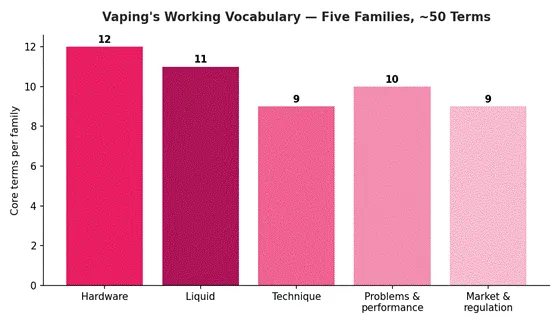
The jargon families at a glance — how vaping’s vocabulary actually organises.
Technique Words: The Skill
The dialect of the inhale, this series’ home territory. MTL (mouth-to-lung): the two-stage cigarette-style draw — mouth first, then down — native to tight airflow and higher strengths. DL or DTL (direct-to-lung): the one-stage deep breath, native to airy hardware and low strengths. RDL (restricted direct-to-lung): the tightened hybrid between them. Draw: a single pull; session: a bounded run of draws — the unit this series teaches vaping in. Priming: saturating a new coil before first fire, the golden rule wearing its proper name. Throat hit: the inhale’s scratch, scaling with nicotine and PG — the sensation ex-smokers navigate by. Cloud chasing: the pursuit of maximum vapour, its own subculture with its own hardware. Stealth vaping: the discretion techniques — long hold, slow low exhale — from the etiquette chapter. And chain vaping: continuous unbounded puffing, the habit most of this series’ technique advice exists to retire.
Performance and Problem Words: The Symptoms
The vocabulary of things going right and wrong — fluency here is diagnosis. Ohms and resistance: the coil’s electrical rating; sub-ohm (below 1 ohm) historically marks the high-power cloud end, while higher-ohm coils serve MTL — for pod users it is mostly trivia, since pods ship matched. Wattage: adjustable power on larger kits, with every coil rating a happy range. Dry hit or burnt hit: the acrid puff of an unsaturated wick — new-coil impatience or an empty tank — permanent once properly scorched. Flooding: the opposite, liquid outpacing vaporisation from hard fast draws, heard as gurgling and felt as spitback (hot droplets reaching the mouth). Coil gunk: the caramelised residue, sweetener-driven, that dulls flavour and ends coil life. Vaper’s tongue: olfactory fatigue — a vanished flavour with a working device — cured by rotation, as the flavour guide details. Ghosting: previous flavours haunting a shared tank across refills. Leaking, condensation, auto-firing: the hardware complaints, each with its chapter in the maintenance guide. Learn these dozen and every forum thread ever written becomes legible.
Market and Era Words: The Landscape
A final layer describes the products and the moment. Disposable: the banned-in-2025 single-use format whose name still haunts search bars; big-puff or 10K-class: the post-ban refill systems — rechargeable devices with high-capacity replaceable pods — that inherited its convenience lawfully. Prefilled versus open system: sealed-pod ecosystems versus fill-your-own hardware, the tier choice from the buying guide. Starter kit: exactly what it says; AIO (all-in-one): integrated designs, mostly a spec-sheet word. Nic-free, and the step-down: the reduction path — 20 to 10 to 0 — that the strength ladder guide maps. Harm reduction: the public-health frame the whole category lives in — less harmful than smoking, for smokers, not harmless, not for anyone else. Black market, grey market, counterfeit: the non-compliant fringe every checklist in this series is built to keep you out of. And vape shop versus specialist: colloquially interchangeable, but this series consistently means the latter — established, age-verifying, notified-stock retail.
Reading a Shelf Label, Narrated
Vocabulary proves itself at the counter, so run one worked example. A pack reads: ‘Prefilled pod, 2ml, nic salt 20mg (2%), 50/50, mesh coil, MTL’ — translated: a sealed cartridge at the legal tank size, filled with the smooth high-strength nicotine form at the legal ceiling, in the balanced base ratio suited to small coils, heated by a modern mesh-style element, tuned for the cigarette-style draw. In one glance you know its hardware family, its target user (a switching smoker or pod vaper), its draw style, its legality, and its compatibility — and the neighbouring bottle reading ’70VG 3mg freebase shortfill’ announces itself just as clearly as cloud-kit territory you can now confidently walk past or toward. That is the entire point of the phrasebook: labels stop being noise and start being specifications, and the shop stops being a wall and becomes a menu. A specialist whose labelling is this legible is itself a quality signal — pink vape organises its range along exactly these vocabulary lines, which is what good vape retail looks like when the dialect is spoken properly on both sides of the counter.
Ten Terms You Can Skip Entirely
A phrasebook should also say what not to bother learning, and vaping’s dialect carries a hobbyist stratum the everyday pod vaper never needs. Rebuilding vocabulary — RDA, RTA, RDTA, decks, wraps of the coil-winding kind — belongs to the workshop subculture that builds its own atomisers; admire it from a distance. Squonk and its bottle-fed mods: a niche’s niche. Temperature control, TCR, and the wire-alloy alphabet (Ni200, SS316): engineering options on advanced mods, irrelevant where pods ship pre-matched. Cloud-competition terms — trick names, drip tips by exotic material — likewise. Mech mods deserve one sentence beyond skipping: unregulated mechanical devices with no protection circuitry are the single hardware category a mainstream vaper should actively avoid rather than merely ignore, since they concentrate exactly the battery risks the safety guide retires. The skip-list is liberating rather than dismissive: fluency, here as in any language, means knowing which registers are yours — and the everyday register this guide teaches covers the entire territory a pod-kit vaper will ever walk.
The Terms Worth Correcting Gently
Every dialect carries a few common misuses worth un-learning. ‘Vapour is just water vapour’ — it is aerosolised PG/VG and flavour, which is fine, but the water claim hands ammunition to anyone who catches the error. ‘Smoking a vape’ — nothing burns; the verb matters more than pedantry suggests, since half the public’s confusion lives in that inherited word. ‘Nicotine causes cancer’ — the myth guide’s flagship conflation, worth the gentle correction that addiction and carcinogenicity are different properties. ‘Stronger is harsher’ — true within freebase, obsolete since salts; form decides feel. And ‘unregulated’ — the legal guide’s territory: UK vaping is tightly regulated, and the word properly belongs only to the fringe that opts out. A vaper fluent enough to make these corrections kindly — once, without the seminar — does more for the category’s public literacy than any pamphlet.
The Bottom Line
Jargon looks like gatekeeping and functions, once learned, as the opposite: forty-odd terms, organised into five natural families, and the whole territory of vaping — its hardware tiers, liquid chemistry, technique schools, failure modes and legal frame — becomes navigable without a guide at your elbow. Nothing in the phrasebook took longer to learn than the confusion it retires, and every other article in this series now reads at full speed. Speak the dialect, read the labels, make the kind corrections, and the counter conversation that once intimidated becomes the two-minute specification exchange it was always meant to be. Adults 18 and over, existing smokers and vapers only, as every chapter closes — and for anyone outside nicotine, here is the only vocabulary needed: no, thanks.
